
Navigate to any location on your computer in a friendly and visually appealing interface while renaming or deleting files using this lightweight application. #File manager #File organizer #Explore file #Explorer #Organizer #Manager

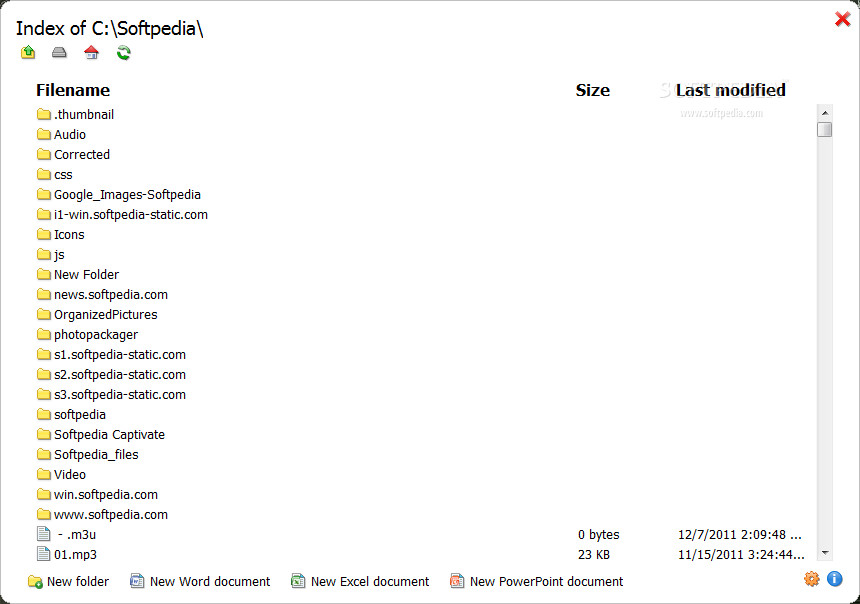
Even though your operating system comes equipped with an explorer that lets you navigate to different locations on your hard disk drive, there are applications with more features. File Explorer is a software designed to help you access your files and folders.
The interface of the program is minimalistic. You can view the size and last date of modification of each file. These can also be sorted by clicking on the dedicated criteria.
As for available features, you can create a new folder, Word, Excel or PowerPoint document, as well as rename or delete files and folders.
You can go up one level, quickly access the drive list, go to the default location and refresh the list.
In the "Options" menu, you can select between two interface languages (English or Dutch), set the home location (application folder, drive list, My Documents, desktop), as well as enable File Explorer to display hidden files. These settings can be restored or saved as default.
The program takes up a very low amount of system resources and didn't freeze, crash or pop up errors during our tests.
But, even so, File Explorer is no match for a full-blown file managing system. It doesn't even support basic commands, such as the cut, copy, paste and search functions.
You cannot even set a custom home location or move files and folders. Also, File Explorer wasn't able to open files of Word formats that we had just created (DOC, XLS and PPT).
File Explorer is certainly simplistic and barely uses system resources. But that doesn't make up for the fact that it lacks the most basic file managing commands. We strongly recommend you look for something else.
File Explorer 1.2
add to watchlist add to download basket send us an update REPORT- runs on:
- Windows All
- file size:
- 640 KB
- filename:
- FileExplorer_v1.2.zip

- main category:
- File managers
- developer:
7-Zip
4k Video Downloader

Zoom Client
Windows Sandbox Launcher
Bitdefender Antivirus Free

Context Menu Manager
ShareX
Microsoft Teams
calibre
IrfanView
- Microsoft Teams
- calibre
- IrfanView
- 7-Zip
- 4k Video Downloader
- Zoom Client
- Windows Sandbox Launcher
- Bitdefender Antivirus Free
- Context Menu Manager
- ShareX