
Comprehensive software that helps you perform various calculations (e.g. molecules, balance, thermochemistry, electrochemistry), analyze molecules and atoms in detail, and view the periodic table with historical information. #Educational tool #Learn chemistry #Molecular 3D viewer #Chemistry #Learn #Calculator

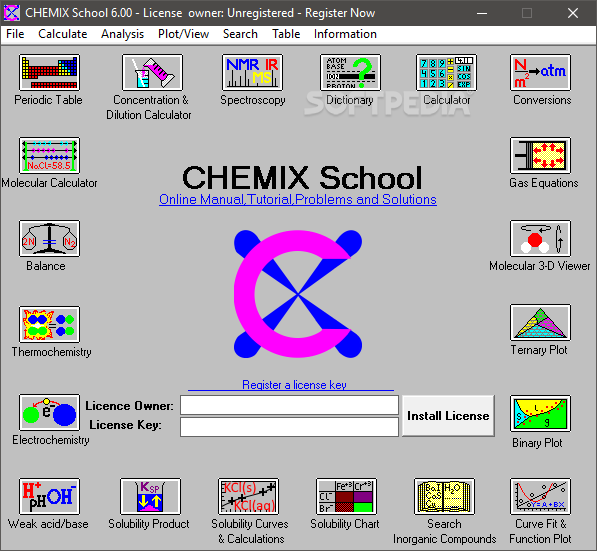
CHEMIX School is a comprehensive Windows application built specifically for helping students, chemists, and teachers learn about a wide range of topics in the area of chemistry.
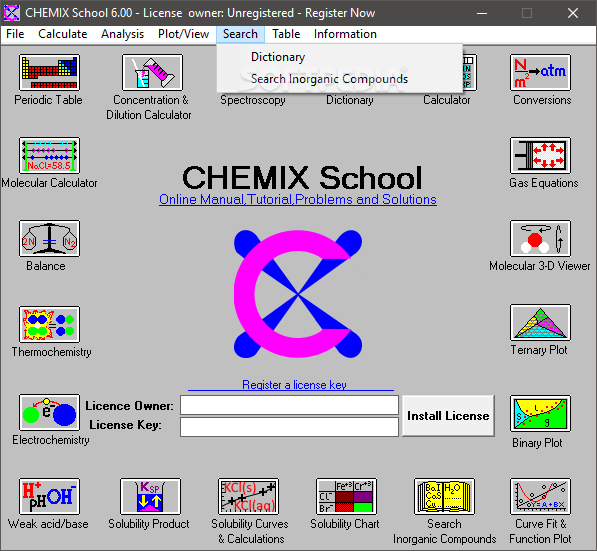
You are welcomed by a minimalistic panel that offers quick access to the chemistry tools that you can work with. Plus, the tool displays suggestive icons near each function, so you can easily differentiate between the built-in parameters.
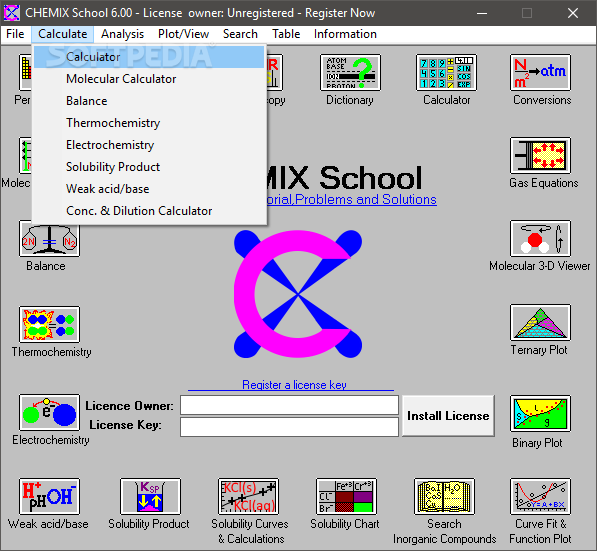
CHEMIX School gives you the possibility to perform diffferent calculations related to molecules, balance, thermochemistry, electrochemistry, solubility, and weak acid/base. For all of the aforementioned categories the program comes packed with predefined formulas, and lets you copy the information to the clipboard, so you can paste it into other third-party utilities.
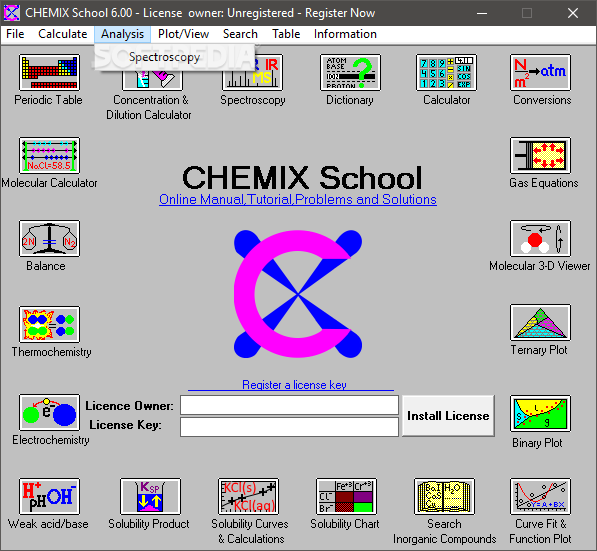
You can also analyze different problems related to spectroscopy area, plot functions, use the built-in molecular viewer for checking out molecules and atoms in detail (you may zoom in or out of molecules or atoms), and use the dictionary for finding out comprehensive information about various topics.
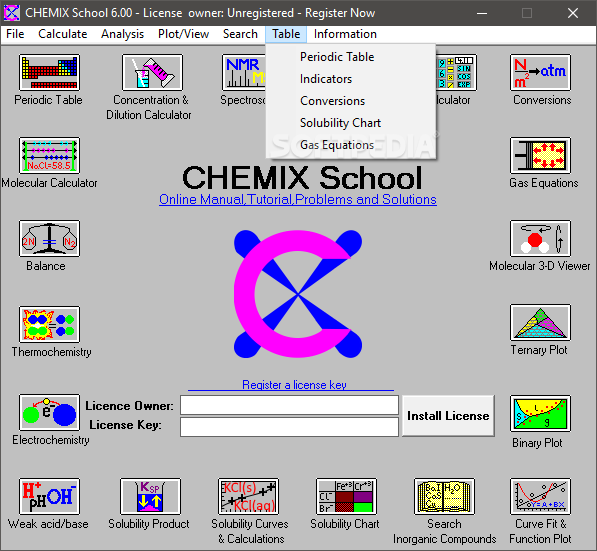
You can view the periodic table and make the application show or reveal various details for each element, such as atomic number, name, melting and boiling points, atomic radius and volume, heat capacity, electrical conductivity, number of stable isotopes, oxidation states, and crystal structure. Plus, you can get detailed history data about each element from the periodic table with a simple right-click mouse operation on the desired item.
What’s more, you can check out the acid-base indicators, perform various conversations related to temperature, pressure, energy, power, force, length, and mass, analyze the solubility chart, and calculate gas equations.
CHEMIX School offers extensive information about different chemistry fields, and is suitable for rookies and professional users alike.
Download Hubs
CHEMIX School is part of these download collections: Chemistry Managers
CHEMIX School 12.5
add to watchlist add to download basket send us an update REPORT- runs on:
-
Windows 11
Windows 10 32/64 bit
Windows 8 32/64 bit
Windows 7 32/64 bit
Windows Vista 32/64 bit
Windows XP 32/64 bit - file size:
- 3.2 MB
- filename:
- cxse_eval_12_5.zip

- main category:
- Others
- developer:
- visit homepage
IrfanView
ShareX
4k Video Downloader

calibre
paint.net
Microsoft Teams
Windows Sandbox Launcher
Bitdefender Antivirus Free

Zoom Client

7-Zip
- Bitdefender Antivirus Free
- Zoom Client
- 7-Zip
- IrfanView
- ShareX
- 4k Video Downloader
- calibre
- paint.net
- Microsoft Teams
- Windows Sandbox Launcher