
Small and fast replacement for the Windows "Add or Remove Programs" utility that allows you to uninstall programs and look for a certain app. #Application remover #Remove program #Uninstall program #Uninstaller #Installed #Uninstall

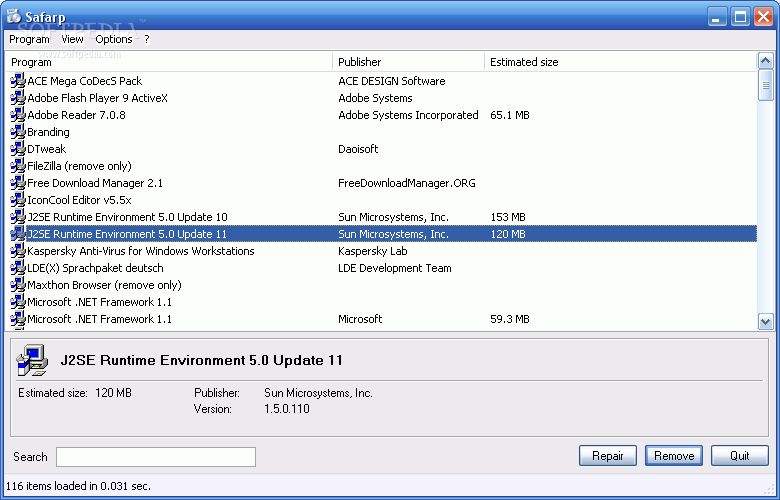
Safarp is a lightweight, yet very powerful software replacement for the standard Windows “Add/Remove Programs” utility, allowing you to uninstall programs with no fuss.
Once launched, the program automatically scans the computer and shows the installed apps, with displayed information including program, publisher and estimated size.
While it shows Windows Updates but doesn’t provide a dedicated feature to hide these updates, Safarp also offers a search field to help you easily find an installed app for on-the-go removal.
There are two ways to uninstall a program at your disposal: the standard one and the quiet one, with the latter especially developed to completely remove an application without interacting with the user at all.
What’s more, Safarp enables its users to save the list of installed apps to CSV, HTML, RTF or TSV, while a “Remove Entry” utility only deletes the program’s entry in the Add/Remove Programs screen and nothing more.
As you can see, Safarp is a very easy to use, but it also comprises some tools that may need additional documentation. Unfortunately, the program doesn’t boast a help section, which can only be bad news for beginners.
On the other hand, Safarp works like a charm on all Windows versions and although administrator privileges are required on Windows 7 workstations, it can easily replace the standard tool integrated into the operating system.
It’s pretty clear that this piece of software can serve its purpose with minimum effort, targeting both beginners and those more experienced who want to remove a program on the go.
What's new in Safarp 0.5:
- Added "Frequency of use" and "Date last used" columns. Columns are now configurable. The list can now be sorted by Program, Publisher, Size, Frequency of use and Date last used.
Safarp 0.5
 Softpedia Editor's Pick
add to watchlist
add to download basket
send us an update
REPORT
Softpedia Editor's Pick
add to watchlist
add to download basket
send us an update
REPORT
- portable version
- Portable Safarp
- runs on:
-
Windows 2003
Windows Vista
Windows XP
Windows 2K - file size:
- 130 KB
- filename:
- safarp-0.5.exe
- main category:
- Tweak
- developer:
- visit homepage
4k Video Downloader

Windows Sandbox Launcher
ShareX
Zoom Client

Bitdefender Antivirus Free

IrfanView
calibre

paint.net
Microsoft Teams
7-Zip
- paint.net
- Microsoft Teams
- 7-Zip
- 4k Video Downloader
- Windows Sandbox Launcher
- ShareX
- Zoom Client
- Bitdefender Antivirus Free
- IrfanView
- calibre