
Create a wireless hotspot on your computer in a quick, convenient manner by turning to this application that packs a random password generator #Hotspot creator #Virtual router #Create hotspot #Wireless #Hotspot #Router
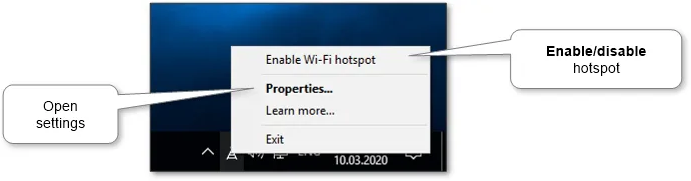
Sometimes, connecting all of your devices to the Internet can be impossible to achieve, mainly because of hardware-related limitations.
However, it is possible to create virtual wireless access points directly from your computer, by turning to third-party software, such as Wi-Fi Hotspot.
Please note that this program requires you to have a wireless adapter and an Internet connection so that it can be used to its full extent.
Deploying this application to your computer can be achieved in a quick, hassle-free manner since you are not required to perform any complex configuration steps.
You just need to accept the End-User Agreement, specify a destination path on your system and follow the on-screen instructions. The program is automatically launched when the setup is finished, which makes it up for not generating a desktop shortcut icon.
Wi-Fi Hotspot packs a minimalistic interface that integrates highly intuitive functions, thus making it possible for a broad range of users to understand and benefit from its capabilities without considerable efforts.
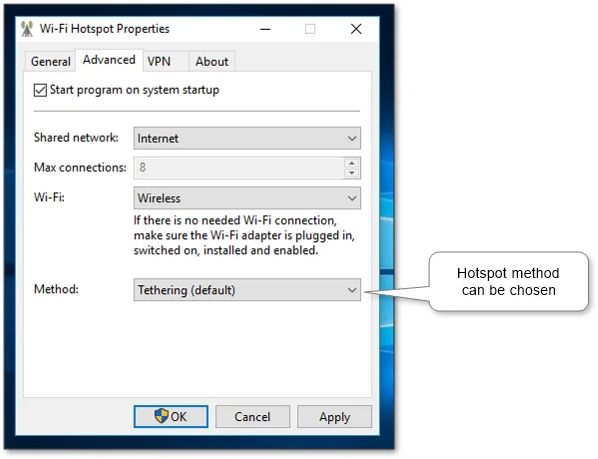
More so, it comes with a configuration menu that is quite simplistic, as you can only adjust a few easy-to-understand parameters, including setting the maximum number of connections or choosing the connection you want to share.
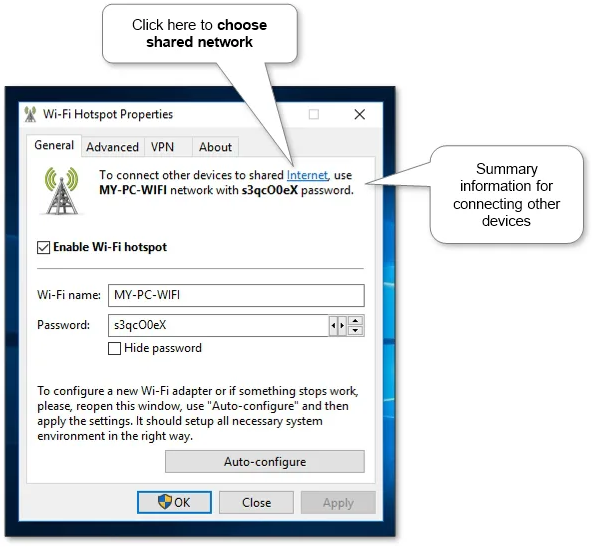
This program can help you create a wireless hotspot on your computer in a quick, effortless manner, by typing a name and a password in the designated fields and ticking the corresponding checkbox.
It provides you with a handy random password generator that you can use to create complex passkeys to protect your hotspot. This tool comes with four directional arrow buttons: the up and down ones are used to create new strings while the left and right ones can increase or decrease the string length.
Wi-Fi Hotspot is a reliable application that can help you create a virtual wireless access point on your computer in a quick, convenient manner. It comes with a simple user interface, packs intuitive functions and features a random password generator, as well.
What's new in Wi-Fi Hotspot 1.1.1 Build 159:
- Improvements:
- KB: Problem resolving mode.
- Showing wrong password length in notification.
Wi-Fi Hotspot 1.1.1 Build 159
add to watchlist add to download basket send us an update REPORT- PRICE: Free
- runs on:
-
Windows 10 32/64 bit
Windows 8 32/64 bit
Windows 7 32/64 bit
Windows Vista 32/64 bit
Windows XP 32/64 bit - file size:
- 2.8 MB
- filename:
- WiFiHotspot.Setup.Exe
- main category:
- Network Tools
- developer:
- visit homepage
Context Menu Manager
Bitdefender Antivirus Free
ShareX
4k Video Downloader

Zoom Client
7-Zip
IrfanView
Microsoft Teams
Windows Sandbox Launcher
calibre
- Microsoft Teams
- Windows Sandbox Launcher
- calibre
- Context Menu Manager
- Bitdefender Antivirus Free
- ShareX
- 4k Video Downloader
- Zoom Client
- 7-Zip
- IrfanView