
A tool for amateur radio operators that allows the reception and the transmission of signals, supporting both PSK31 and PSK63 operational modes. #PANORAMIC reception #PANORAMIC transmission #Panoramic Tuning #Panoramic Tuning #PSK31 #PSK63

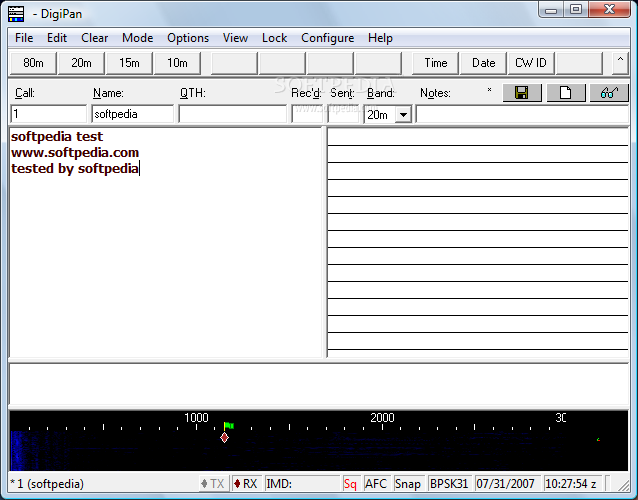
DigiPan is dedicated mainly to amateur radio operators, providing them with a tool for PSK31 and PSK63 real-time conversations between multiple stations across the world. Its name is short for 'Digital Panoramic Tuning' and its purpose is to instantly decode radio signals within your receiver's range, while providing a simplified visual representation of all the QSOs.
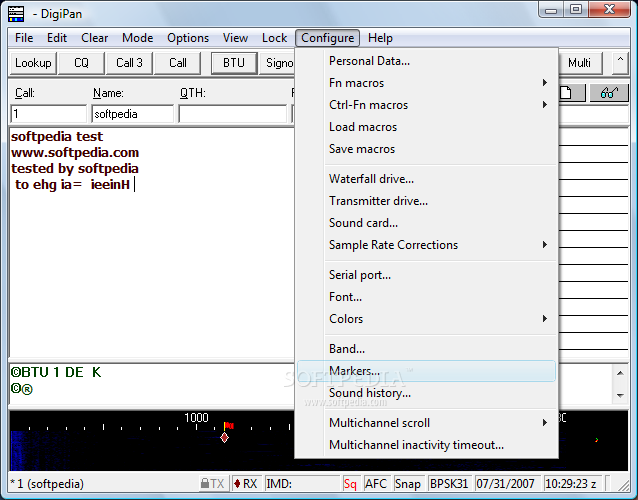
Configuring the application is not difficult, that is, if you are accustomed to this type of software, but solid knowledge is required to understand the meaning of all the technical terms. At first launch, you are prompted to enter your personal data, such as the call sign, your QTH and name.
DigiPan supports dual and multi-channel reception and can be configured to use a microphone instead of the computer's sound card, in order to capture Single Sideband signals. As mentioned above, it supports both PSK31 and PSK63 modes, the latter addressing faster typists.
One of its advantages is that it can generate a waterfall frequency spectrum display of the text conversations within a range that depends on your transceiver's capabilities, enabling you to monitor sent and received messages from and to a large number of stations.
Clicking on one of the vertical lines in the spectrum displays the corresponding text within the main window. For your convenience and easier control, the application features customizable shortcut keys.
CQ calls are highlighted for easier identification and sent text can be underlined for the same purpose. PACTOR RX signals are supported and sample rates can be corrected. All the stations are automatically decoded by the application, which shows you the updated call-signs and conversations.
DigiPan provides an interface that helps you perform PSK31 and PSK63 operations. With the proper knowledge and the right configuration, it allows one-click tuning and radio conversation capturing.
What's new in DigiPan 2.0:
- Added multichannel reception, CQ alert, Internet callsign lookup, and Rx and Tx offset adjustment.
DigiPan 2.0
add to watchlist add to download basket send us an update REPORT- runs on:
- Windows All
- file size:
- 651 KB
- filename:
- digipan20.exe

- main category:
- Others
- developer:
- visit homepage
Context Menu Manager
4k Video Downloader
Microsoft Teams
Zoom Client
calibre
ShareX
Windows Sandbox Launcher
Bitdefender Antivirus Free

7-Zip
IrfanView
- Bitdefender Antivirus Free
- 7-Zip
- IrfanView
- Context Menu Manager
- 4k Video Downloader
- Microsoft Teams
- Zoom Client
- calibre
- ShareX
- Windows Sandbox Launcher