
A utility that was designed to check for files named FILE????.CHK and try to recover and restore the original files with the correct extension. #File Checker #Check File #CHK File #Checker #Check #CHK
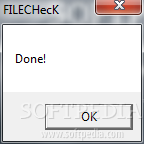
Restoring damaged files after a program or the entire system crashes is a delicate job, but using the appropriate tools it can be safely carried out even by users who are not experts in computers. Usually, after such an unwanted event, Windows attempts to rescue the data for the running applications and stores all the available data as file fragments.
Using one of the built-in system tools for scanning and checking disks, CHKDISK and SCANDISK will reveal these containers in the form of CHK files. Now, in order to use them to restore data from a program that was running before the crash occurred, tool like FileCHK is required.
This particular program will work only with those files whose names follow this scheme: FILE****.CHK. Fortunately, this software solution supports a wide variety of filetypes which include documents, video, audio, graphic, CAD and other formats.
Since FileCHK has no interface, there are no configurations to be made and it is ready to run right out of the box. However, there is a requirement that must be followed when using this application, more precisely it has to be copied and deployed from the same directory where thew CHK files are stored.
The main strong points of this utility are the blazing fast speed with which it processes the fragment files and the high success rate. Almost all the files that are recovered and reconverted to their initial form by FileCHK no longer exhibit any problems when they are opened.
All things considered, in case you are in dire need of reverting the damaging effects of a system or application crash, you can surely give this application a try because it will most likely recover the data, provided that the CHK files are generated correctly.
- PRICE: Free
- runs on:
- Windows All
- file size:
- 10 KB
- filename:
- FileCHK.zip
- main category:
- System
- developer:
- visit homepage
ShareX
Microsoft Teams
IrfanView

Zoom Client
4k Video Downloader

calibre
Windows Sandbox Launcher
Bitdefender Antivirus Free

7-Zip
Context Menu Manager
- Bitdefender Antivirus Free
- 7-Zip
- Context Menu Manager
- ShareX
- Microsoft Teams
- IrfanView
- Zoom Client
- 4k Video Downloader
- calibre
- Windows Sandbox Launcher