
Put your hard disk drive under the scope to get in-dept info regarding transfer rate, access time, burst speed, damaged blocks and more. #Monitor HDD #Measure performance #HDD monitor #HDD #Measure #Performance

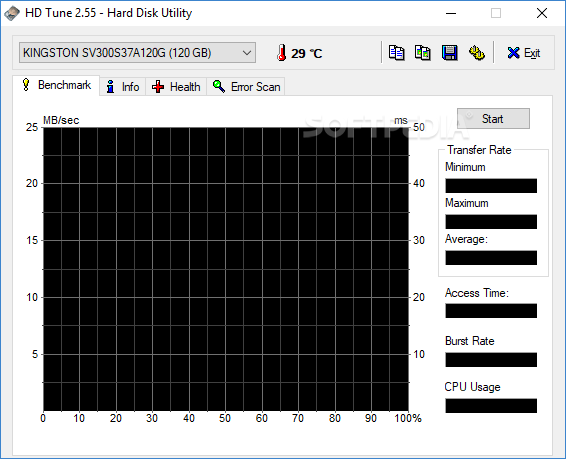
If you're on the lookout for a powerful yet easy to use hard-disk utility that can test your HDD and display valuable information about the device, chances are you've come to the right place. Among the software solutions that are designed for analyzing and scanning disks for errors while also showing all the details that count about a hard drive, HD Tune claims to offer exactly the things a user would need.
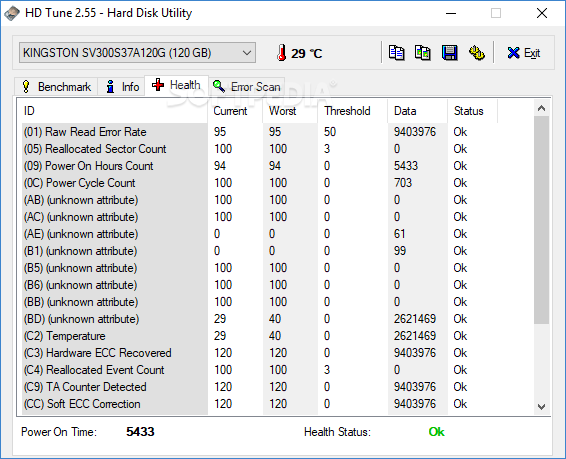
With a very user friendly interface, this utility makes all its functions accessible from the main window which is organized in 4 tabs especially for this purpose. A nice extra is the fact that HD Tune can show you the current temperature for the selected HDD.
This application is able to conduct a benchmark to show you the minimum, the average and the maximum transfer rates, alongside burst rate and access time. Another ability of HD Tune is the error scan it can conduct in order to show you if there are any damaged blocks.
Probably the most impressive thing is that the application runs very smoothly, so you can easily start a benchmark while continuing to work without being bothered by the ongoing process.
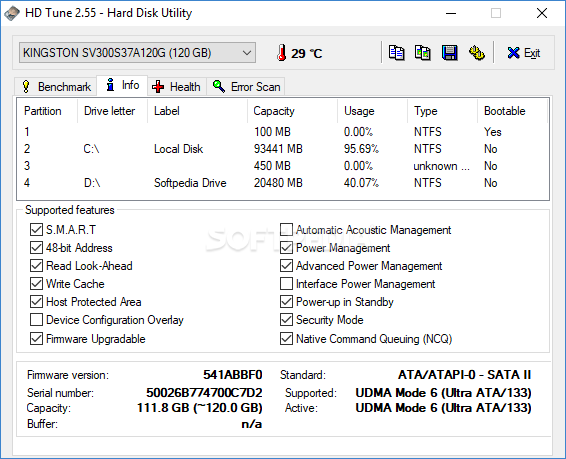
The 'Info' tab of HD Tune displays all the features supported by your hard drive as well as some partition information. You can even view the firmware version, serial number and buffer capacity for your HDD
Overall, HD Tune remains a great piece of software, especially for beginners who simply need a means of quickly evaluating the performance of their hard disks. Thanks to the great ease of use and good feature pack this application definitely deserves a spot high on the recommendations list.
Download Hubs
HD Tune is part of these download collections: HDD Managers
HD Tune 2.55
add to watchlist add to download basket send us an update REPORT- PRICE: Free
- runs on:
-
Windows 10 32/64 bit
Windows 2003
Windows 8 32/64 bit
Windows 7 32/64 bit
Windows Vista 32/64 bit
Windows XP 32/64 bit
Windows 2K - file size:
- 627 KB
- filename:
- hdtune_255.exe
- main category:
- System
- developer:
- visit homepage
calibre
Windows Sandbox Launcher
Bitdefender Antivirus Free

Microsoft Teams
ShareX
Zoom Client
IrfanView
7-Zip
Context Menu Manager
4k Video Downloader

- 7-Zip
- Context Menu Manager
- 4k Video Downloader
- calibre
- Windows Sandbox Launcher
- Bitdefender Antivirus Free
- Microsoft Teams
- ShareX
- Zoom Client
- IrfanView